
72-Hour Grindstone Family Readiness Guide
WHEN THE LIGHTS GO OUT: PREPARING FOR POWER OUTAGES
Power outages often accompany severe storms, flooding, high winds, ice, and other emergencies.
Sometimes electricity is restored within a few hours. Other times, damaged power lines and blocked roads can leave homes without power for several days. A little preparation can keep your household safer, calmer, and better connected while repairs are underway.
Start With Reliable Lighting.
Every household should have more than one dependable source of light. Do not rely only on the flashlight built into your phone. Using your phone as a flashlight drains the same battery you may need for emergency calls, weather alerts, directions, and communication with family.

Consider including:
-
LED flashlights
-
Battery-powered lanterns
-
Headlamps for hands-free lighting
-
Extra batteries in the correct sizes
-
Rechargeable lights
-
Solar-powered lanterns
-
Small motion-activated lights for hallways and bathrooms
-
A flashlight stored beside each bed
Headlamps are especially helpful when preparing food, caring for children or animals, checking damage, or moving through a dark building.
Test your lights regularly and make sure everyone knows where they are stored.
Emergency supplies are not helpful if they cannot be found in the dark.
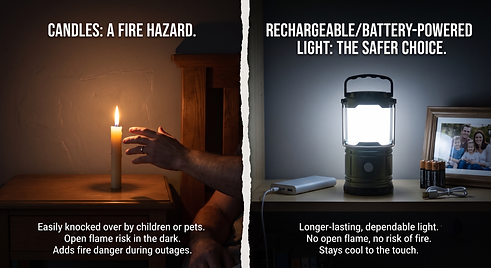
Use Battery-Powered Lights Instead of Candles. Candles may seem like a simple solution, but they add a fire hazard during an already difficult situation. A candle can easily be knocked over by a child, pet, or someone moving through a dark room. Battery-powered flashlights and lanterns provide safer, longer-lasting light without an open flame.
Keep Communication Devices Charged.
During an outage, your phone may become your primary source for
emergency alerts, weather updates, maps, and communication.
Before severe weather arrives:
-
Fully charge phones and tablets.
-
Charge portable power banks.
-
Make sure charging cables are stored with the power banks.
-
Place devices in low-power mode when electricity goes out.
-
Lower screen brightness and close unnecessary applications.
-
Use the phone’s flashlight only when necessary.
-
Consider keeping a charging cable that works in your vehicle.
Power banks slowly lose their charge while sitting unused. Add them to your regular preparedness check and recharge them as needed. A solar charger or larger portable power station can provide additional backup, but make sure you understand its capacity before depending on it. A small battery bank may charge a phone several times, while larger power stations may operate lights, radios, fans, medical equipment, or small appliances for a limited period.

Decide What Actually Needs Power.
Not every appliance needs to remain operational during a 72-hour outage. Make a list of your household’s priorities before an emergency occurs.
These may include:
-
Cell phones
-
Medical equipment
-
Refrigerators or freezers
-
Emergency radios
-
Fans during extreme heat
-
Limited lighting
-
Well pumps
-
Communication equipment
Knowing your priorities will help you choose the correct backup power equipment and avoid wasting limited battery capacity or generator fuel. Anyone who depends on electrically powered medical equipment should have a specific backup plan. Speak with the equipment provider, medical professional, or local emergency management office before an outage occurs.
Generator Safety Is Not Optional.
Portable generators can provide valuable backup power, but
improper use can cause carbon monoxide poisoning, electrocution, fire, or death. Always operate a generator outdoors, far from the house and away from doors, windows, vents, garages, basements, crawlspaces, and other enclosed or partially enclosed areas.
Never operate a generator:
-
Inside a house
-
Inside a garage, even with the door open
-
On a porch
-
Under an attached carport
-
Near an open window or door
-
In any area where exhaust can enter the building
Install working carbon monoxide alarms with battery backup and test them regularly. Do not connect a generator directly to a household outlet. This dangerous practice, known as backfeeding, can send electricity into utility lines and may electrocute utility workers, neighbors, or members of your household. If you want a generator connected to your home’s electrical system, have a qualified electrician install an approved transfer switch.
Use only properly rated, heavy-duty outdoor extension cords. Keep the generator dry, follow the manufacturer’s instructions, and allow it to cool before adding fuel. Store fuel in approved containers and away from living areas, ignition sources, and heat.

This Week’s Preparedness Step
Gather every flashlight, lantern, power bank, and charging cable in your home.
Test each item. Replace weak batteries. Recharge your power banks. Then place the equipment
where it can be reached quickly—even in complete darkness. Preparedness does not require purchasing everything at once. Begin with what you already own, identify the gaps, and add to your supplies a little at a time. A working flashlight, a charged phone, and a safe backup-power plan can make a major difference when the lights go out.
Stay ready. Stay safe. Take care of one another.